

Retail Mystery Shopping: Strengthening Age Controls and Responsible Sales at the Point of Sale

Retail Mystery Shopping: Strengthening Age Controls and Responsible Sales at the Point of Sale
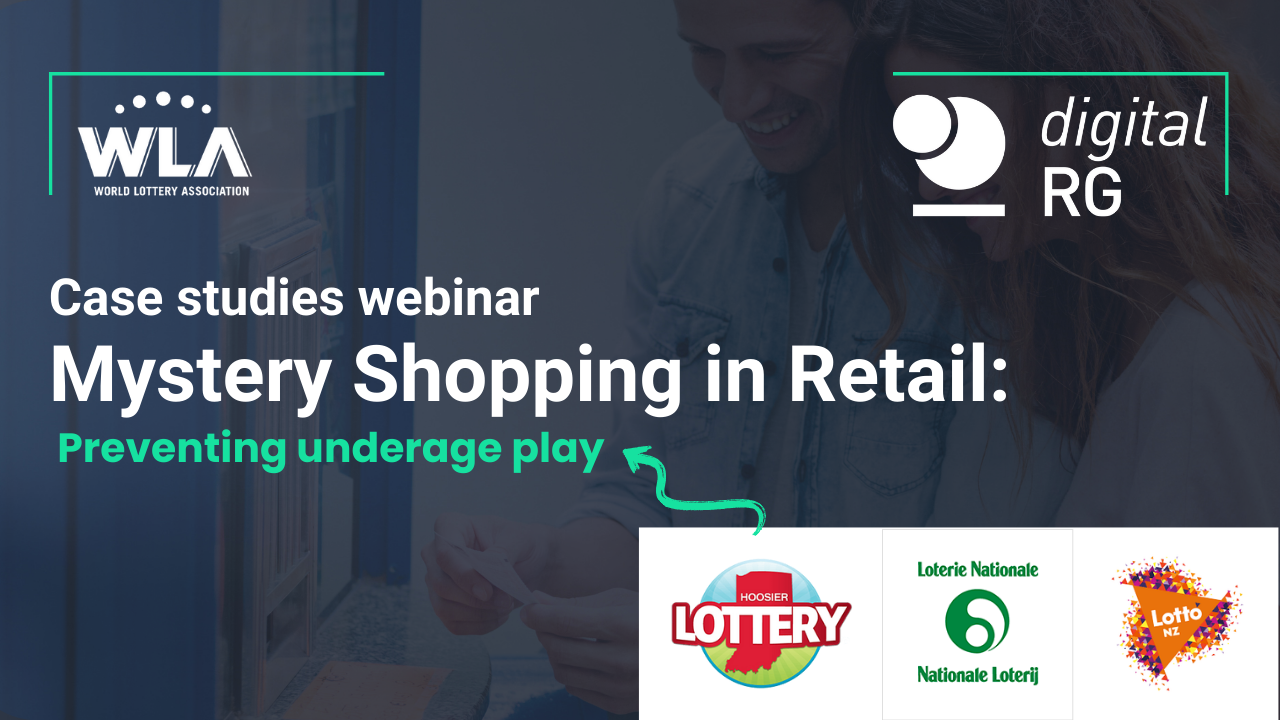
Retail mystery shopping has become one of the most effective tools available to lotteries to assess how responsible gaming policies are applied in real-life retail environments, especially on topics around underage play prevention. On 15 January, digitalRG and the World Lottery Association hosted a dedicated webinar bringing together international lottery leaders to explore how mystery shopping programmes can help prevent underage play and strengthen responsible sales practices.
The webinar, Mystery Shopping in Retail: Preventing Underage Play, attracted more than 150 participants from 41 countries, reflecting the global relevance of this topic. Representatives from Africa, Asia-Pacific, Europe and the Middle East, Latin America, and North America joined the session to hear how leading lotteries are designing, implementing, and improving large-scale retail mystery shopping initiatives
Why mystery shopping matters in retail lotteries
Mystery shopping provides lotteries with objective, real-world insight into what happens at the point of sale, something that cannot be fully captured through policies, training materials, or internal audits alone. By observing retailer behaviour in everyday conditions, lotteries can assess whether age-verification rules are being followed, whether responsible gaming messages are applied consistently, and how staff respond in situations involving potential underage customers.
Importantly, mystery shopping is not only about compliance. When implemented effectively, it becomes a learning and improvement tool, helping lotteries identify gaps, recognise good practice, and tailor retailer support in a meaningful way.
Setting the scene: Project RED and shared learning
The session opened with an introduction to Project RED, presented by Luca Esposito Poleo, Executive Director of the World Lottery Association. Project RED is a WLA initiative designed to promote shared learning, practical tools, and collective progress across the lottery sector, particularly in areas linked to responsible gaming and retail operations.
Within this context, mystery shopping was positioned as a mechanism that supports both regulatory compliance and positive social impact, reinforcing the role of lotteries as responsible operators in their communities.
Find out more info on the WLA website here.
Retail mystery shopping in practice: Case Studies from 3 lotteries
The core of the webinar focused on concrete examples from three lotteries operating in very different regulatory and cultural environments. Despite these differences, several common themes emerged.
🇧🇪 Loterie Nationale Loterij, Belgium
Frédérique Niemegeers, Head of Mystery Shopping, Retail Back Office & Support Management at the National Lottery of Belgium, shared how a structured and well-established mystery shopping programme can support long-term improvement.
The Belgian approach emphasises:
Clear and consistent evaluation criteria
Regular feedback to retailers
Strong alignment between mystery shopping outcomes and retailer support measures
Rather than treating mystery shopping as a one-off control mechanism, the programme is embedded into broader retail management processes. This ensures that results are understood, acted upon, and followed up, creating a cycle of continuous improvement rather than isolated interventions.
🇺🇸 Hoosier Lottery, USA
A contrasting but complementary approach was presented by Kate Carlson, Corporate Social Responsibility and Compliance Director at the Hoosier Lottery in the United States.
The Hoosier Lottery has deliberately moved away from purely punitive models and instead introduced a positive incentive-based mystery shopping programme. Key elements include:
Recognition and certification for retailers who meet age-verification standards
Clear communication about expectations and outcomes
Active involvement of sales teams to reinforce responsible practices
This model acknowledges that retailers are partners in player protection. By rewarding good performance and making responsible behaviour visible and valued, the programme has helped increase retailer buy-in and normalise age checks as a standard part of the sales process.
The discussion also highlighted how certificates and recognition can act as non-monetary incentives that still carry significant value for retailers, particularly when supported by sales teams and internal communications.
🇳🇿 Lotto New Zealand
The final case study came from Lotto New Zealand, presented by Anna Aucamp, Responsible Gambling Lead, and Antonia Mitford-Burgess, Enterprise Risk Manager at Lotto New Zealand.
Their presentation showed how mystery shopping can be embedded within a broader enterprise risk framework, linking retail behaviour directly to organisational risk assessment and mitigation strategies.
By analysing mystery shopping results alongside other risk indicators, Lotto New Zealand is able to:
Identify systemic issues rather than isolated incidents
Prioritise interventions where risk is highest
Align responsible gambling efforts with overall governance and assurance processes
This integrated approach reinforces the idea that preventing underage play is not solely a retail issue, but a core organisational responsibility.
Certification, standards, and continuous improvement
The webinar also highlighted the role of responsible gaming certification in reinforcing good practice. During the session, digitalRG shared updates from the latest certification cycle, with 20 lotteries announced today as having achieved the WLA Responsible Gaming certification framework across Levels 2, 3, and 4 demonstrating ongoing progress across the sector.
Certification was discussed not as an end goal, but as a framework that supports structure, accountability, and continuous development, particularly when combined with practical tools such as mystery shopping programmes.
Participants were reminded of the upcoming certification deadline and encouraged to view retail mystery shopping as a valuable source of evidence when demonstrating compliance and maturity within responsible gaming frameworks.
The discussions throughout the webinar highlighted that retail mystery shopping is most effective when it is approached as a tool for learning and improvement, rather than simply a mechanism for control. Programmes that prioritise positive reinforcement, clear communication, and meaningful retailer engagement are more likely to deliver sustainable results and embed responsible sales practices at the point of sale.
Equally important is what happens after the visit. Clear feedback loops ensure that mystery shopping findings translate into concrete action, whether through targeted training, operational adjustments, or enhanced retailer support. When integrated into broader risk management and governance frameworks, mystery shopping becomes a powerful contributor to overall player protection strategies.
Finally, the value of shared learning across jurisdictions was a recurring theme. By exchanging experiences and practical insights, lotteries can accelerate progress, avoid common pitfalls, and strengthen responsible retail practices collectively.
Retail remains one of the most critical environments for preventing underage play. As demonstrated during this webinar, well-designed mystery shopping programmes can play a central role in protecting players, supporting retailers, and reinforcing public trust in lottery operations.
Watch the full webinar:
Answering Questions asked during the event:
Is the mystery shopper process carried out by the lottery itself or is an external company hired? If you do it yourselves, how do you ensure the objectivity of the study?
Loterie Nationale Belgium uses an external company to conduct its mystery shopping process to avoid bias. Before each wave, retailers are randomly selected by a bailiff, while underage mystery shoppers are chosen by a jury of five members, including two external representatives from Prodipresse and Perstablo. For in depth information on the process, find more info here.
The Hoosier Lottery conduct its own mystery shopping process due to challenges with third-party licenses.
What is the reason for products having different legal ages, the type of game? The associated risk, or what is the justification?
You can dive into a detailed research and case study from digitalRG available here to digitalRG premium members.
This document covers three main areas:
Overview of age limits worldwide: Table of major Western jurisdictions and the minimum legal age for different gambling products.
Recent changes to age limits: Jurisdictions or companies that have changed their minimum gambling age in the last five years, and summarise the nature and timing of these changes.
Arguments for and against raising age limits: Arguments and examples, both in favour of and against raising minimum gambling ages, including regulatory, public health, commercial and practical considerations.
We are currently in exchange with our regulator on KPIs - which pass rate would you recommend? We're currently at 90 % success rate p.a. for mystery shopping with both minors and young adults (up to 22yrs of age).
There are many factors to consider when determining pass rates, such as how long the programme has been running, the methodology, the types of checks, the incentives or punishments used… Many lotteries set different target pass rates; however, pass rates tend to fall between 70% and 95%. Explore an in-depth case studies here.
How do you manage the participation of underage mystery shoppers in terms of parent authorisation (and school days)?
Some lotteries use adults who appear to be under 18 as mystery shoppers. For example, as part of its updated Operation Guardian initiative, Allwyn conducted more than 8,200 mystery shopper checks in 2024 to assess whether retailers were properly verifying customers' ages who might appear under 18. These checks were carried out by adults aged 18 or over who appeared younger, ensuring the visits did not put retailers at risk of breaching age-restriction laws (Allwyn, 2025). Explore an in-depth case studies here.
Has it been measured whether this mysterious customer, this responsible gaming control, also leads to an increase in sales?
No – but it clearly enables a lottery to keep its licence to operate and increase brand value.
If you find repeated underage sales violations, do you have the authority to terminate your cooperation/partnership with that retailer, for example?
Hoosier Lottery stated that it has the authority to terminate retailers for failing to comply with regulations. However, this is not the first step that is taken after a failed mystery shopping exercise. If a retailer fails, they are given training straight away to educate them on the correct rules and regulations. The idea is to implement training to reduce the chance of tickets being sold to minors. In extreme circumstances, where retailers have failed to learn from past mistakes, termination can result.
Category
Other Blogs

November 21, 2025
Tackling Retail Emissions in the Lottery Value Chain: Insights from the EL Webinar
October 27, 2025
Jogo Responsável e Sustentabilidade: Destaques da EL/WLA Vienna Conference 2025
October 27, 2025
Perspectivas de la EL/WLA Vienna Conference 2025
October 23, 2025
Insights from the EL/WLA Vienna Conference 2025

August 18, 2026
Cómo formar a sus minoristas con digitalRG

August 18, 2026
Comment former vos détaillants avec digitalRG

August 17, 2026
How to Train Your Retailers with digitalRG

July 24, 2026
Lancez votre soumission WLA : ce que votre loterie doit savoir avant le 1er octobre