

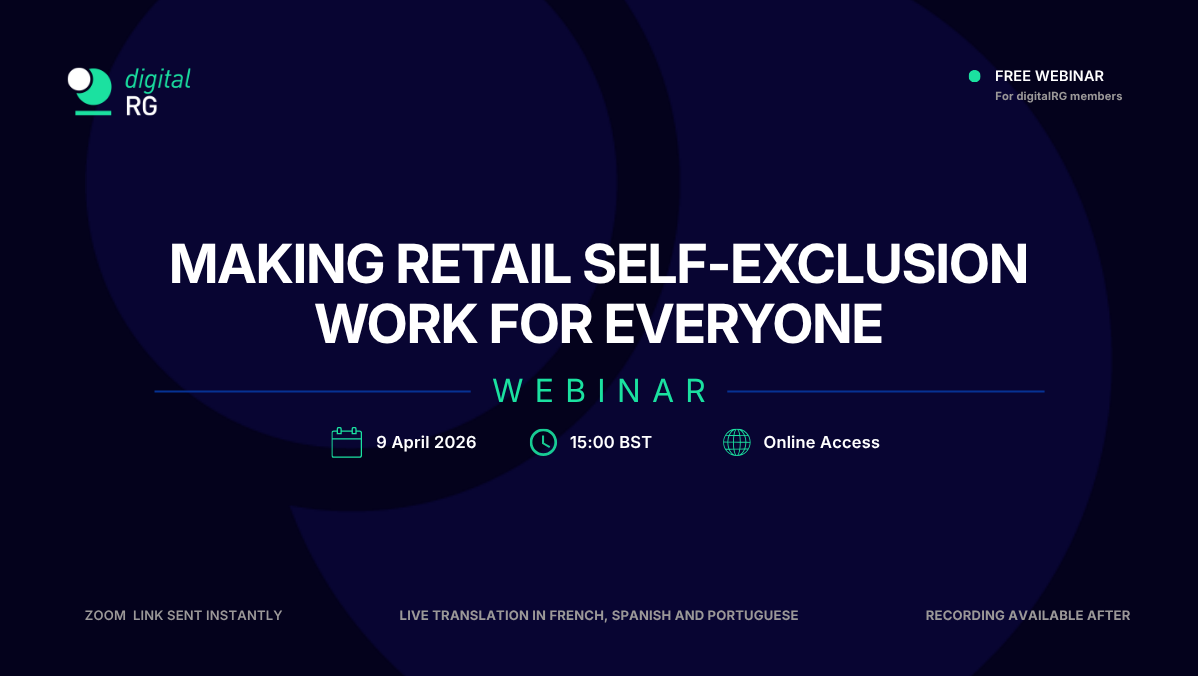
Making Retail Self-Exclusion Work for Everyone

Making Retail Self-Exclusion Work for Everyone
Retail self-exclusion remains one of the most complex areas of player protection for lotteries. In digital environments, restrictions can be applied through accounts, logins and automated controls. In retail, however, the reality is very different. Transactions take place quickly, across large networks of physical locations, and often without permanent player accounts to rely on.
These challenges were the focus of digitalRG’s recent webinar, Making Retail Self-Exclusion Work for Everyone, which brought together practical examples from the Romanian Lottery, Jogos Santa Casa and Lotería Chaqueña. Although each organisation operates within a different regulatory framework and retail structure, the session highlighted a shared conclusion: retail self-exclusion is not simply about introducing a rule. It is about making that rule workable in everyday retail settings.
Across all three presentations, one message stood out clearly. Simplicity, consistency, training and support are essential if retail self-exclusion is to function effectively in practice.
Why retail environments require a different approach
Retail settings present particular challenges for implementing exclusion measures. Staff often work under time pressure, interactions take place face to face, and decisions may need to be made quickly at busy counters. Retailers are expected to balance customer service with compliance responsibilities, sometimes with very limited time to respond.
At the same time, retail offers something digital channels cannot always provide: direct human interaction. When frontline staff are properly supported, retail environments can become important spaces for early intervention and meaningful player protection.
Rather than treating retail self-exclusion as impractical, the webinar showed how lotteries are increasingly developing solutions that make it both achievable and sustainable.
Turning frameworks into practical action
The Romanian Lottery presented how a centralised national self-exclusion database can be translated into day-to-day retail procedures across a large network. In this model, operators are required to verify player status and deny access where appropriate, making compliance a structured and mandatory process.
What stood out in this example was the emphasis on implementation. Biannual training, knowledge testing, coordinator supervision and regular communication across the retail network help ensure that procedures are applied consistently at the point of sale. The presentation highlighted three key principles for success in retail environments: simplicity, clarity and confidence.
Using identification systems to support exclusion in retail
Jogos Santa Casa demonstrated how Portugal’s NIF coupon system enables retail self-exclusion without requiring a dedicated player card. Originally introduced to meet identification requirements, the system created a reliable mechanism for blocking excluded players directly at the terminal level.
Under this approach, once a player’s exclusion request is confirmed, their tax number is blocked in the system and bets are automatically rejected at retail terminals. Later improvements, including ID card scanning through updated terminals, further strengthened compliance and reduced operational friction for retailers.
This example shows how existing identification processes can become an effective foundation for retail self-exclusion when they are designed with practical implementation in mind.
Connecting exclusion with wider support
The case study from Lotería Chaqueña (Argentina) added another important perspective by showing how retail self-exclusion can develop in response to player needs as well as regulatory expectations. In this example, exclusion was linked to broader responsible gambling processes, follow-up actions and referral pathways rather than being treated only as a technical restriction.
This approach highlights the importance of viewing self-exclusion as part of a wider support framework. Retail interventions can create opportunities not only to prevent transactions, but also to guide players towards additional assistance when needed.
What lotteries can take away
Taken together, the examples shared during the webinar point to several practical lessons for lotteries working to strengthen retail self-exclusion:
- Simple procedures are more likely to be applied consistently in busy retail environments
- Staff need confidence and training, not just written instructions
- Identification systems can support effective exclusion without requiring full account structures
- Technology should reduce friction at the point of sale
- Self-exclusion works best when connected to wider support pathways
Retail self-exclusion is not only about preventing access to gambling products. When implemented effectively, it becomes a realistic and impactful player protection measure in the environments where everyday gambling decisions are actually made.
Access the Full Insights Article and Webinar Recording
A more in-depth Insights article, including detailed explanations of the case studies from the Romanian Lottery, Jogos Santa Casa and Lotería Chaqueña, is available to digitalRG Premium members.
Premium members can also access the full webinar recording, featuring practical implementation perspectives from all speakers and additional discussion on how retail self-exclusion can be applied across different operational environments.
To find out more about membership and how digitalRG can support your organisation with tools, templates and expert-led insights, contact hello@digitalrg.com or book time for a chat here: https://calendly.com/digitalrg/quick-intro-call.
Category
Other Blogs

March 12, 2026
O Poder das Pessoas: Levando a Sustentabilidade para a Vida no Trabalho

March 12, 2026
Le Pouvoir des Citoyens: Mettre en Pratique le Développement Durable au Travail

March 12, 2026
El Poder de las Personas: Llevar la Sostenibilidad a la Vida Laboral

March 10, 2026
People Power: Bringing Sustainability to Life at Work

August 18, 2026
Cómo formar a sus minoristas con digitalRG

August 18, 2026
Comment former vos détaillants avec digitalRG
August 17, 2026
How to Train Your Retailers with digitalRG

July 24, 2026
Lancez votre soumission WLA : ce que votre loterie doit savoir avant le 1er octobre