

How Loteries de Catalunya created an audit-ready training system for points of sale

How Loteries de Catalunya created an audit-ready training system for points of sale
All lotteries that operate with retail point-of-sale networks face the same challenge: the people selling their products are rarely direct employees of the organisation. Staff turnover is high, email addresses are often unavailable, and yet auditors continue to demand evidence that responsible gambling training has been delivered and has been effective.
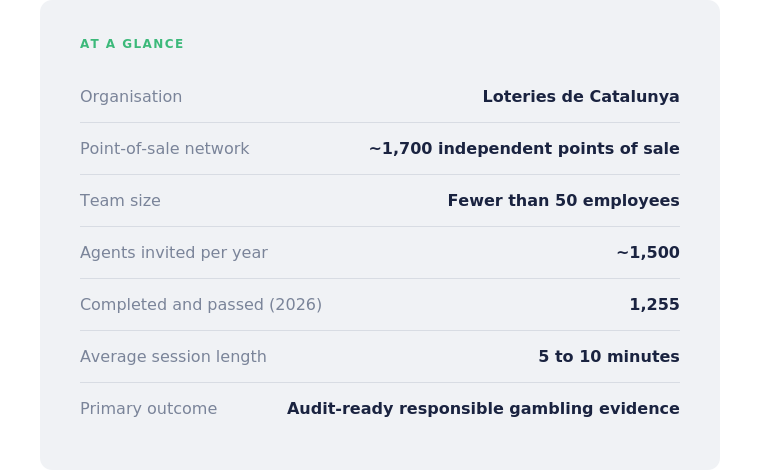
Loteries de Catalunya has addressed these challenges by transforming routine point-of-sale visits into a scalable responsible gambling training and audit system. It now reaches around 1,500 sales agents per year, of whom more than 1,250 completed and passed the training in 2026, with a satisfaction rate above 98%. The system also generates verified, audit-ready evidence as a direct output, with no spreadsheets or unnecessary admin required.
If your lottery relies on independent retailers, field visits and fragmented contact data, this challenge will probably sound familiar.
Marta Rodelas García, the Sustainability Manager who oversaw the programme, recently explained the process in a webinar, where she outlined how they adopted a new way of working alongside digitalRG.
A challenge shared by almost every lottery
For any lottery with a distributed point-of-sale network, the constraints will feel familiar. Loteries de Catalunya does not own the outlets where its products are sold. It cannot close them for an afternoon and gather all staff in a training room, as each one runs its own business. Customer-facing staff change frequently, and many of these people do not appear on any lottery employee list, so there is no reliable email address to reach them.
Even when training was delivered, there was no clear way of knowing who had completed it, who had skipped it, or whether the information had been understood. When an audit arrived, proving that training had been delivered across 1,700 points of sale meant gathering evidence manually. This old way of working was time-consuming and operationally complicated.
There are also real risks if the process is not carried out with the necessary rigour. Formal penalties for selling to minors represent a significant threat, and the cost of getting it wrong affects not only the lottery's reputation but also the trust built with regulators and the wellbeing of its players.
The question is no longer whether the point-of-sale network should be trained, but how to do it effectively and, above all, in a way that can be verified.
The breakthrough: a second purpose for visits that were already happening
The core idea behind this model is simple. The Loteries de Catalunya commercial team already visits these points of sale every month to check that products are displayed correctly, that the outlet meets the required standards and that the brand is represented appropriately. That is exactly where the opportunity lies.
Working with digitalRG, the team designed a training workflow built around this reality. Because it was integrated into a routine the commercial team was already carrying out, the rollout required no new field operations, no dedicated retailer events and no significant logistical changes. The visit itself was not changed. It simply gained a new purpose.
For lotteries operating with independent sales networks and high staff turnover, this is the key element that makes the model genuinely repeatable and scalable.
From paperwork to evidence
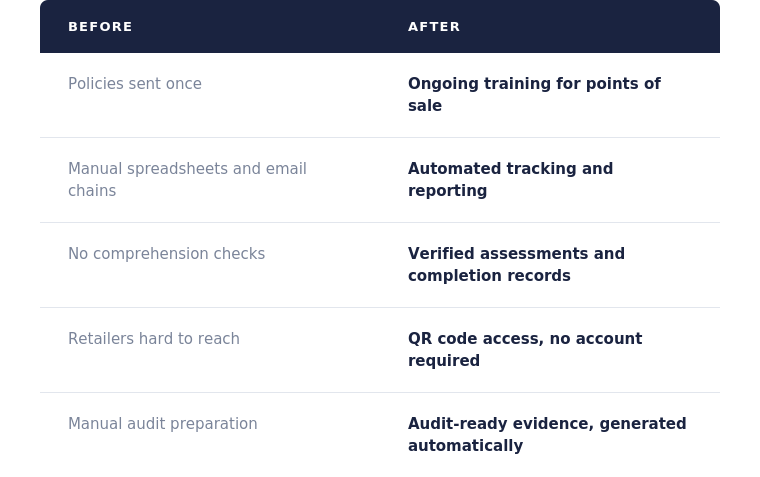
The previous model had clear limitations. It relied on drafting a policy, sending it out once and hoping it would be read. The audit evidence amounted to little more than the document itself and the date it was sent. There was no real way of verifying whether the content had been read, understood or whether it had brought about any change at the point of sale.
The change Loteries de Catalunya made was not to improve the document. It was to replace the model entirely.
How the new model works
From the sales agent's perspective, the whole process takes around ten minutes. From the lottery's perspective, it runs as a repeatable cycle:
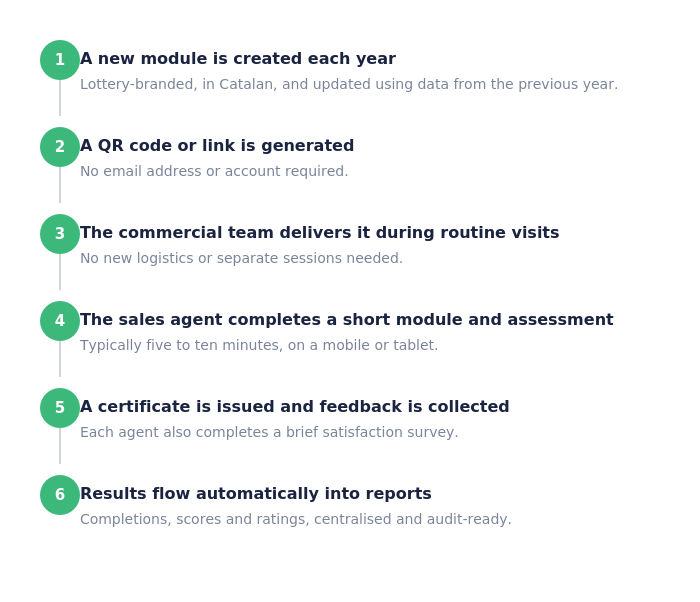
Each year, Loteries de Catalunya works with digitalRG to develop the module, known in Catalan as L'essencial per a agents de venda. It is kept deliberately short and updated annually, incorporating new content based on data from the previous year, which helps identify the main areas for improvement.
For the point-of-sale network, where personal email addresses are often unavailable, the team generates a link or QR code that anyone can use without needing an account. That detail is what allows the model to reach the entire network, not just the people the lottery has on record. During a routine visit, a member of the commercial team opens the link on a phone or tablet and hands it to the person behind the counter. The agent enters their agent number and the shop name, so the record is linked to a specific point of sale, and then completes the video, the assessment and the survey. The same link can also be sent remotely via WhatsApp or email, or displayed as a QR code at the end of an in-person session.
The results
Using this new model, the team invited 1,500 agents, of whom 1,255 completed and passed the training. The satisfaction rate remained above 98%. And there is one figure Marta is particularly proud of: the proportion of agents who said the training had increased their knowledge rose from 93% to over 95%.
The evidence behind those figures also helped Loteries de Catalunya obtain its responsible gambling certifications from the European Lotteries Association and the World Lottery Association.
"What has really changed for us is having solid evidence. Before, we could say we had delivered the training. Now we can show how it is working. When the audit comes and the auditor asks for proof, it is straightforward. We have everything, detailed and ready to use."
Marta Rodelas García, Sustainability Lead, Loteries de Catalunya
More than compliance
If you ask Marta what she would like other lotteries to take away from this experience, her answer has nothing to do with software:
"Responsible gambling should not sit with one department. It needs to be a governance issue, a thread that runs through every level of the organisation."
There is also a more human element to it. Sales agents enjoy completing the training, and the certificate is often displayed proudly behind the counter, in full view of customers. This reinforces their sense of belonging to the lottery and its commitment to player protection, rather than feeling like just another anonymous sales channel.
“This is not just training to tick a compliance box. We are building trust with the network that distributes our products. And the agents recognise that, year after year.”
Category
Other Blogs

May 20, 2026
Cómo Loteries de Catalunya creó una formación para puntos de venta preparada para auditorías

April 27, 2026
ISO 37001:2025 - O que a Atualização da Norma Antissuborno Significa para Loterias e Jogos

April 27, 2026
ISO 37001:2025 - Mise à Jour de la Norme Anti-Corruption pour le Secteur des Loteries et Jeux
April 27, 2026
ISO 37001:2025 - Lo que la Actualización del Estándar Antisoborno Significa para Loterías y Juegos

August 18, 2026
Cómo formar a sus minoristas con digitalRG

August 18, 2026
Comment former vos détaillants avec digitalRG

August 17, 2026
How to Train Your Retailers with digitalRG
July 24, 2026
Lancez votre soumission WLA : ce que votre loterie doit savoir avant le 1er octobre